


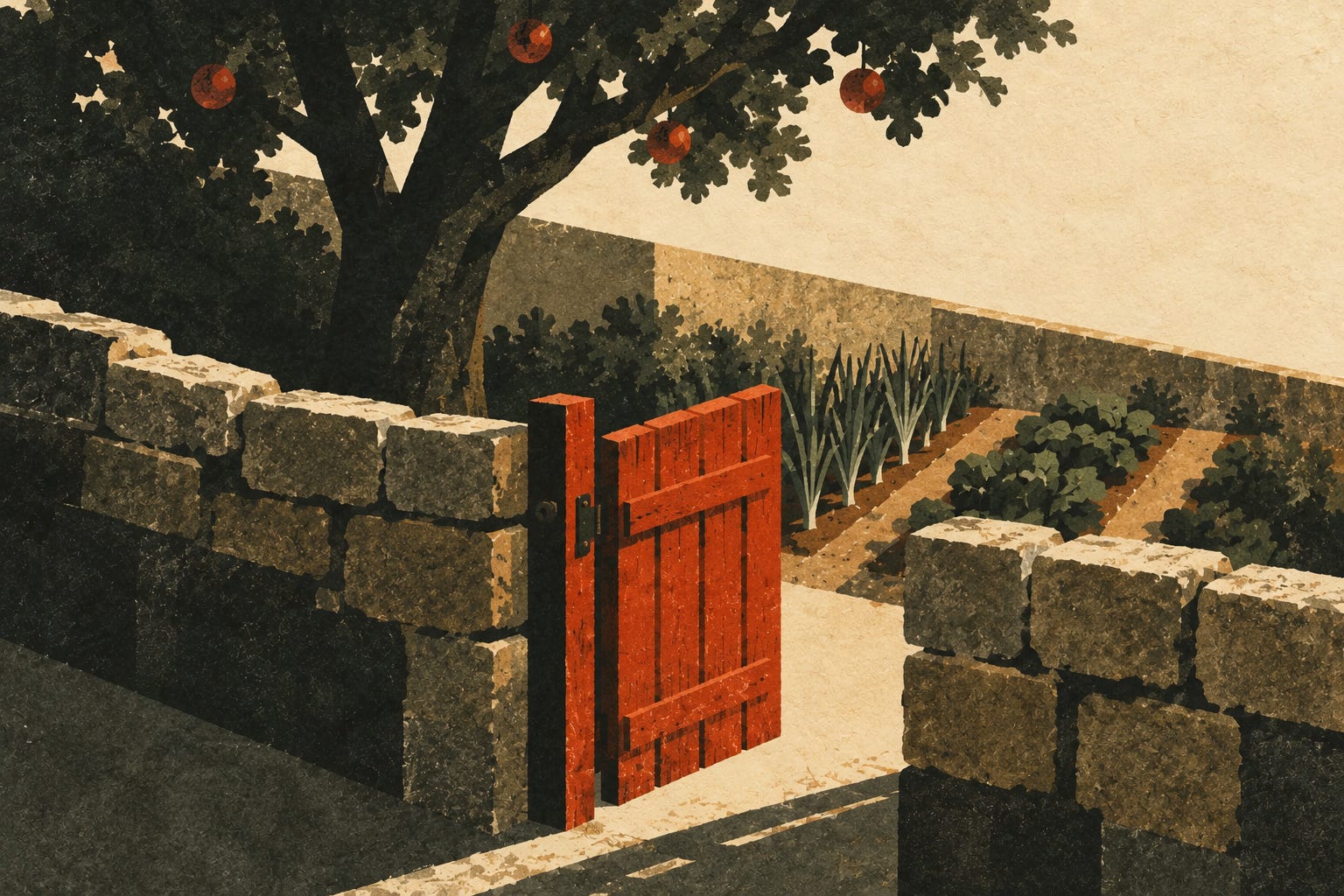
“We have tried to escape the sweat and sorrow promised in Genesis – only to find that, in order to do so, we must forswear love and excellence, health and joy.”
— Wendell Berry
In his essay “Quantity Versus Form,” author, poet, and essayist Wendell Berry tells the tragic story of a woman named Lily.
She had sold her home and all of her remaining possessions. Having no children of her own, and with her husband having passed away, she found herself alone in the hospital with pneumonia and multiple broken bones caused by osteoporosis.
Wendell Berry decided to go visit her and described Lily as being in the most excruciating amount of pain any human could bear. To his shock and horror, he found that the doctor had removed her pain medication to increase her appetite in hopes of what he told Wendell was to see her “getting her back on her feet.”
Just a few weeks earlier, Berry had stood with Lily as she prepared to leave her home and possessions behind. When he asked how she felt about the whole ordeal, she answered with words that seem almost impossible to imagine saying in our day:
“I’m all finished now. Everything is done.”
That’s not a word you hear every day.
Finished.
In our world of advanced technology and the latest medicine, there is always something else to do. One more thing to try. Another possibility to pursue. One more chance to “get her back on her feet.”
But back on her feet for what reason and what purpose?
It’s a fearful question, Wendell says. Someone else’s suffering is no place to casually practice philosophy. That desire to help Lily recover and live longer is understandable, and none of us should presume to decide when another person has lived enough.
But her own words and the estimation of her own life deserve to be heard and held closely. She seemed to possess something our shared cultural obsession with “more” makes difficult to recognize: a sense of completion and a realization she had enough and had been enough.
Berry describes this final stage of life as “ripeness,” a readiness for death that belongs within an understanding of a whole circle of life and death we all live in.
In considering what such a “good” life might look like, he writes:
“This is a fearful question and it ought to be fearfully answered. Probably it should not be answered for anybody in particular by anybody else in particular. But the ancient norm or ideal seems to have been a life in which you perceived your calling, faithfully followed it, and did your work with satisfaction; married, made a home, and raised a family; associated generously with neighbors; ate and drank with pleasure the produce of your local landscape; grew old seeing yourself replaced by your children or younger neighbors, but continuing in old age to be useful; and finally died a good or a holy death surrounded by loved ones.”
The promise of more
I was recently on a long drive from Georgia back home, and flipped on a podcast to hear from longevity advocate Bryan Johnson speak about his pursuit of eternal life and “preciousness of existence.” I found myself wrestling in my mind with the stark contrast of his vision next to that of Wendell Berry’s “ripeness” and satisfaction.
Bryan Johnson is a man devoting extraordinary attention to remaining alive. His body has become something to monitor, measure, and continually correct. His obsession and ambition centers around controlling his life in order to survive until the autonomous nanobots run by artificial intelligence can flow through his bloodstream and make constant corrections to his genes that, in theory, allow him to embrace and say “yes to the incomprehensible preciousness of existence.”
At first I wore a mental smirk listening to his comments. But the more I listened, the more deeply I understood the attraction.
I want more years with my wife. Of course I want to see my children grow up and see what they do and who they become.
I didn’t want to see my grandmother die this year, or my mentor and friend to tragically die a few years ago. I didn’t want my Mom to have cancer, or to see others in my family go into a hospital never to come out again.
If someone I love receives a terrible diagnosis, I want the research, the treatment, the discovery to arrive just in time. I would be grateful for the people who refused to accept a limit they could overcome.
But does preciousness require endlessness?
It would be too easy to treat Bryan Johnson as a strange man with a strange obsession and leave it at that. But the desire underneath his project is one I battle almost daily: somehow, some way, I can have more control. More certainty. More life. And with control I’ll have less pain and less suffering. To “escape the sweat and sorrow promised in Genesis,” as Wendell Berry has put it.
My version of control is less elaborate but just as obsessive as Bryan Johnson’s. It often begins with the belief that I am just one more piece of information or one more “hack” away from finally getting control of my life and circumstances.
One more book. One more conversation. One more tool that will help me put everything in its proper place and give me what I so desperately desire.
There is always more. There is always another possibility, another project, another thing that suddenly seems too important to leave alone. The world is full of good things, and I would like to participate in absolutely all of them.
Unfortunately, I have been issued one limited body within limited time and space.
The promise of technology and intelligence meets me right where that unfulfilled desire and longing is. It promises that I can finally do more than my limits allow. Perhaps I can escape the difficult work of deciding what will remain undone.
And that’s where the “Never Die” movement’s longing is painfully recognizable in my own heart and soul.
Then what?
Suppose AI gives us the abundance and freedom we desperately seem to want. It cures our disease. It extends our lives. It makes work optional. All our frictions are wiped away.
Then what?
I don’t believe the good life is merely a continued existence. The good life is found in truth, beauty, hard work, belonging, sacrifice, limitations, dependence, and finally, a good death.
A 150-year frictionless abundance machine may not be utopia at all.
It brings up so many questions I believe we ought to be asking:
If there is no work, what happens to excellence?
If there is no dependence, what happens to love?
If there are no more physical limits, what happens to a focus on health as wholeness?
If there is no friction, what happens to formation?
If there is unlimited information, what happens to our attention?
If there is unlimited abundance, what happens to satisfaction?
I want abundance to accomplish what its advocates say it will accomplish. I want people to flourish. But this requires some understanding of what flourishing means beyond having unlimited resources available.
A longer life still has to be lived. An empty calendar still has to be filled. Freedom from a burden leaves us with choices about what deserves our now fully available strength.
A meaningful and purpose-filled life involves truth, beauty, belonging, sacrifice, useful work, and love. These realities ask something of us. They take time. They require our attention. Often they require us to surrender a possibility we would prefer to keep.
If the future gives us more freedom, we will need the wisdom to use it.
And wisdom has never been something that arrives with an instruction manual of the newest innovation.
What work gives us
My concern becomes concrete when the promise turns to the “end of work” predicted by many AI leaders.
“Money won’t matter in 2036,” Elon Musk smirked earlier this year as he spoke with the Economist to share his predictions in the future.
In this future, robots (embodied intelligence) will be creating so much abundance and resources that work as we know it will become obsolete.
Contributing to a world of justice, goodness, and flourishing is a task I want to actively participate in. What we cannot do is confuse or lose sight of what actual flourishing might look like.
I want to see people flourish in their work by designing and creating both physical and non-physical environments that allow them to do just that.
The problem is there is a dramatically different worldview among many at the helm of those designing artificial intelligence that demonizes and destroys the core of what makes us human: work. They would reject outright my belief in the fundamental role of work and the good limitations of our control over our lives.
I know I’m in the minority, and I’m fighting against my own heart and desires.
One of the most damning realities is we all now live in a society primarily sold out to the cult of leisure. Its cardinal sin is work, and its heretics are people like me who argue for the dignity of work. We are led to believe that the great tragedy of Work is the burden that the promise of progress will finally free us from.
I believe however that work gives us opportunities to encounter the reality that our greatest purpose is in doing and creating something for others, and that this delivers a joy and satisfaction nothing else can provide. Someone needs something. We learn how to provide it. We become capable, reliable, useful. Our effort exists in a world occupied by other people who we are called to serve and to love.
Maybe a future with less compulsory labor could make more room for that kind of world. Maybe we could better care for family members, make things, teach, grow food, or serve our neighbors.
But for this reality to exist, we will have to cultivate those desires right now. We can’t build a culture that treats every demand as an inconvenience and then assume that once we are liberated from the necessity of work and given leisure, we will spontaneously become generous.
The things that get in our way
Another great promise of our future of progress is the removal of friction.
I love removing friction when I am trying to complete a form, fix a scheduling problem, or find the elusive information necessary to make a decision. There are plenty of difficulties I would happily never experience again.
But eliminating friction is not always the right thing to remove when things get in our way.
A confusing process gets in my way. But so do my family’s needs when I have already decided how I want to spend my afternoon.
A broken tool slows me down. So does having to listen long enough to realize that I misunderstood someone.
These experiences require different responses. Some call for better design. Others call for slowing down, intentionally listening, and usually some painful repentance.
If I have created the habit of treating every interruption as an obstacle to my preferred experience, I will eventually begin treating everyone in my life that way. I see everything through the lens of removing friction.
Love is most demanding in the places where control is most attractive.
Other people have their own fears, desires, habits, and inconveniently independent minds that don’t always agree with my own thoughts and desires. They can’t always explain what they need. They don’t become easy to love because I have optimized my life.
I am quite capable of knowing what love requires while preferring something easier. No technological advance has relieved me of my need to become less selfish and more loving.
But it does give me more sophisticated ways to avoid noticing.
What happens to desire
This is where my concern turns deeply spiritual.
A good desire can begin to warp and become an “incurviture” where it turns inward completely and demanding things it has no right to demand. It’s a disordered desire that turns a good thing and warps it in such a way all I can see is myself.
My desire to provide for my family can consume the attention my own family needs. My desire to understand can become an inability to act without certainty. My desire to rest can turn into a life organized around avoiding whatever is difficult.
The original good desire remains recognizable, but warped in its ultimate application. That is part of what makes the distortion and disorder really hard to see.
I want knowledge. I want to rest. I want security. I want another year with people I love.
But I can ask these good things to save me from the vulnerability and reality of being human, and use them to avoid the need to trust in Someone and Something greater than myself. I can organize my life around obtaining enough things to finally feel beyond the reach of need.
This is all deeper than excessive screen time or using a chat bot to answer my questions.
It’s the constant pull towards idolatry: asking something created to bear the weight that only the Creator can bear.
“Endless scrolling is symptomatic of the restlessness we experience when we are unable or unwilling to attend to reality,” says Luke Burgis.
That restlessness is so pervasive in my life. One more piece of information feels like progress, even when it helps me avoid something I already know I need to do.
Technology becomes central in that process. A system that continually learns what holds my attention has opportunities to reinforce desires I have barely examined. What feels like another harmless choice can become a habit, and a habit can become part of my character.
This is where it becomes a spiritual and outside force working on me. Demonic is certainly a word some might use.
“Technology is a cloak for these unseen forces,” argues Burgis.
Of course, I do not need to imagine a machine with demonic intentions to take it seriously. Human beings are already quite capable of building destructive tools to exploit one another’s weaknesses.
Nor can I assign responsibility to the algorithm. I bring something to the exchange. The algorithm works because some part of me wants to accept it.
That is why I worry about the picture of humanity quietly embedded in our tools. Are we being helped to live more deeply in reality, accept responsibility, and love particular people? Or are we being trained to expect a world that continually rearranges itself around our increasingly disordered desires?
Over time, those expectations will travel with us even when we put the device down.
A life with a shape
The Christian worldview begins with gifts and limits together. Its central theme is God humbling himself and taking on the limitations of a man and dependence on His father, ultimately dying a sacrificial death he did not deserve. And he defeats the grave, rendering Bryan Johnson’s pursuit meaningless if the resurrection of Jesus is true.
We receive a world we did not create. We receive bodies, relationships, and responsibilities. Work belongs within that original goodness. So does dependence on the Gardener and his creation.
Disease can devastate a life. Poverty can close off possibilities that should have been available. Relieving those burdens is good work.
But there is a dark side to living in constant dissatisfaction with reality.
“The more superficial and unsatisfying our lives become,” says Wendell Berry, “the faster we need to progress. When you are skating on thin ice, speed up.” We worship at the altar of more, and reject any ideas of wholeness, holiness, or health.
“The sense of right proportion and scale cannot survive the loss of the sense of relationship, of the parts to one another and to the whole. The result, inevitably, is ugliness, violence, and waste.”
Berry would argue that the unholy exchange is this: if we indulge our limitless desire for limitless quality, we actually lose everything that is most desirable. This limitless future destroys what he describes as “Completeness, grace, and beauty that come only by subordinating one’s life to the whole of which it is a part.”
We are left fragmented and broken, forever incomplete, destined for distorted desires that can never be satisfied.
But needing others is not a defect to engineer away. Having to choose where to give our attention is part of having attention to give. Making a promise means accepting obligations that tomorrow I may find inconvenient.
A marriage has a shape because certain possibilities have been surrendered. A home becomes a home because we remain long enough to care for it. A craft becomes ours because we practice when we would rather be doing something else.
There are goods we can receive only by allowing our lives to take a particular shape.
My fear is that we will become so practiced at expanding our options that we will lose the willingness to commit to any of them.
We will have more possibilities than ever, and less ability to say what they are for.
Everything is done
I want to participate in building a just and flourishing world. I want to use these tools well. I want the discoveries that relieve suffering and the improvements that help people do meaningful work.
But I want to keep asking: What are our improvements improving?
Lily’s life brings me back to the question with which I began.
“I’m all finished now. Everything is done.”
At this current moment, I am not ready to say that. I want more time, and there is work I still hope to do. Death remains an enemy; accepting mortality does not require pretending it isn’t that.
But I would like to become the kind of person who could actually recognize completion when it came.
I would like to have given myself to something more substantial than keeping every possibility open. I would like my family to have received my attention, my neighbors to have received my care, and my work to have served people beyond myself.
More years might help me do those things.
An obsession with prolonging them might also help me postpone them or miss them entirely.
That is the strange goodness of limits. They confront me with the fact that this life is being lived now, among these people, in this particular place. I have a membership, and with that a sacred duty to a particular people and place.
I cannot do everything. I cannot keep everyone forever. I cannot wait until I have finally secured myself against sorrow before I begin to love.
Awesome depth and beautiful writing, Tim. The manner in which you expressed your thoughts, teed up questions and explored answers is becoming rarer and rarer today. Keep at it. Many of us out here are grateful.